Book Review of “No Bullet Got Me Yet: The Relentless Faith of Father Kapaun”
By Brigid Hickman
Somebody must be praying hard for us. No bullet got me yet although my pipe got wrecked and the day before yesterday a machine gunner sprayed us with bullets but we jumped into the ditch too quickly.” – Chaplain Kapaun’s last letter sent home to his parents before his capture, Late October 1950
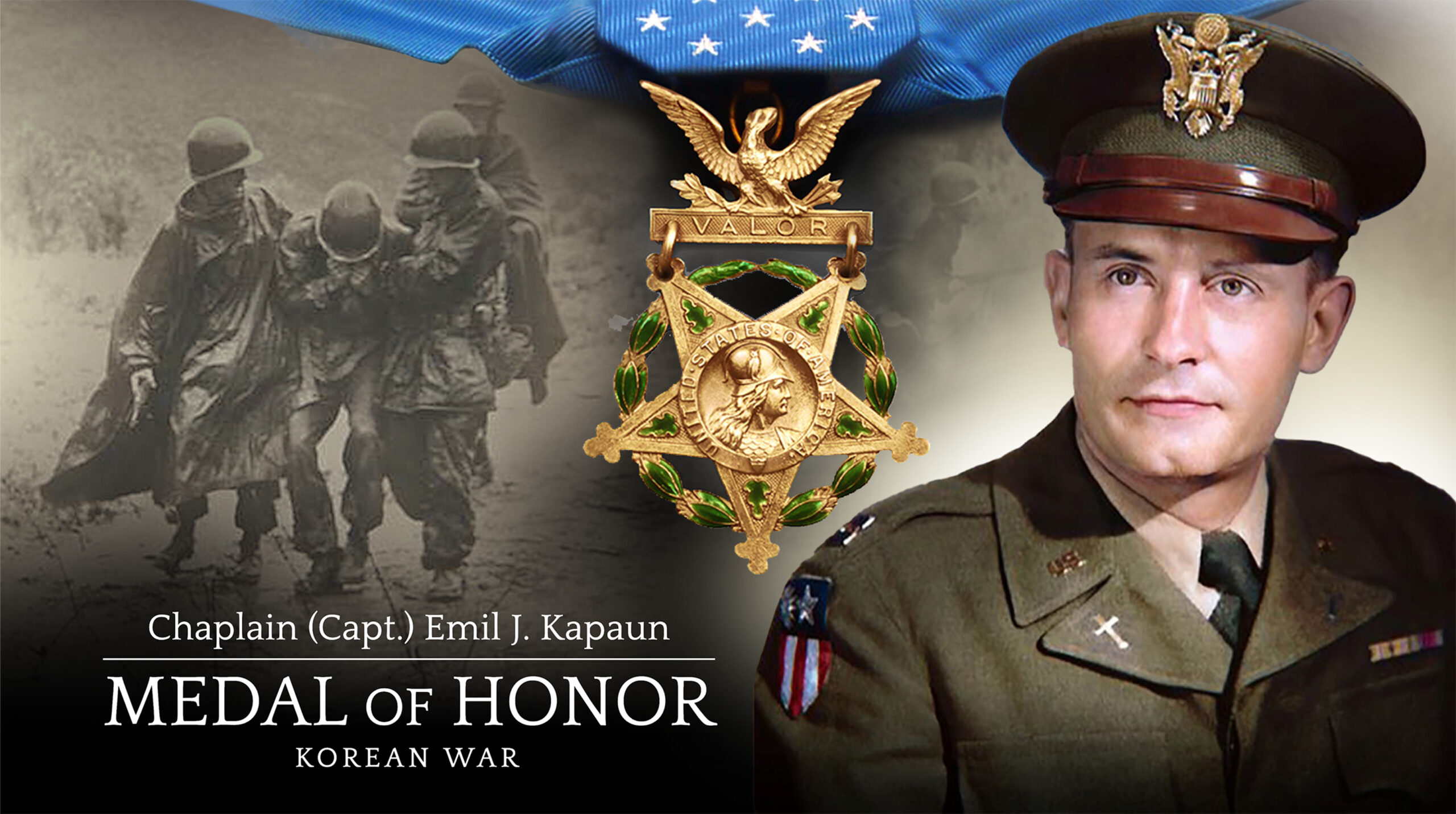
Today, July 18, marks the 54th anniversary of the U.S. Army’s 1st Cavalry Division landing at P’ohang-dong, South Korea in response to the June 25, 1950 invasion by the North Korean People’s Army (NKPA). The “First Team” earned its moniker as the first U.S. forces to land in Manila in February 1945 and, seven months later, spearheaded the occupation of Tokyo. Living up to its name, the storied unit would become the first to arrive in the North Korean capital of Pyongyang in October 1950. Military history and American popular culture generally gloss over the Korean War, although the Army has long celebrated the legacies of Task Force Smith, Gener Matthew Ridgway, and the recently deceased Colonel (Retired) Ralph Puckett. Until the release of “Devotion” in 2022, Hollywood had not produced a major movie on the Korean War since 1977’s “MacArthur” starring Gregory Peck. But over the past five years, interest in the peninsular conflict has steadily grown due to an unlikely hero from the war: U.S. Army Captain Emil Kapaun. While assigned to the 1st Cavalry Division, Kapaun became the most decorated chaplain in U.S. military history, earning the Congressional Medal of Honor, the Distinguished Service Cross, Legion of Merit, and the Bronze Star with “V” Device for valor.
Chaplain Kapaun’s heroism ranks as perhaps the U.S. military’s most powerful story of the Korean War, if not the entire 20th century. John Stansifer masterfully brings Kapaun’s story to life in his new biography No Bullet Got Me Yet: The Relentless Faith of Father Kapaun. This book is for everyone, regardless of religious or military affiliation. Chaplain Kapaun pursued and achieved excellence in virtue as a Soldier, Army Officer, and shepherd. He answered the call to service three times in his life: first as a priest, then as a chaplain in World War II, and finally as a chaplain in the Korean War. The NKPA took Kapaun prisoner after the Battle of Unsan in November 1950; he ultimately died in captivity at a POW camp along the Chinese-North Korean border on May 23, 1951. Kapaun’s heroic actions during the battle, along multiple death marches, and in the prison camps kept his fellow POWs alive and intimidated their captors. Father Kapaun’s leadership, bravery, and resistance tactics later influenced the development of the U.S. military’s Code of Conduct.
As today’s U.S. Army pivots from the Global War on Terror to Large Scale Combat Operations, this book offers myriad lessons in leadership, resilience, and faith that Soldiers of all ranks must inculcate to maintain the American people’s trust and defeat our enemies in battle. It should also not be lost upon readers that Father Kapaun died at the hands of Chinese and North Korean communists—the same regimes that today still pose national security challenges to our nation, the Indo-Pacific region, and the globe.
Of Humble Origins
First generation American Emil Joseph Kapaun was born in a Pilsen, Kansas farmhouse on April 20, 1916. His father Enos was born in Czechoslovakia to a German-Bohemian family that emigrated to America when Enos was a child. Emil’s mother Bessie, also of Bohemian descent, was born in Kansas. Emil grew up in a tight knit ethnic community that spoke both English and Bohemian. He embraced the hard, manual labor required on his family farm, maintaining a full schedule of work, study, prayer, and family time during his adolescent years. He enjoyed sports, fishing, hunting, hiking, and repairing and building items around his community–skills that later drew him to the Army (Stansifer, pp. 35-38, 40-41).
A gifted student, he excelled in academics, particularly in foreign languages. In high school, he began discerning the priesthood and in 1936 entered seminary in St. Louis. Kapaun desired to be a missionary, a demanding vocation that drew upon his deep care for others, his sense of adventure, and foreign language skills. Between semesters in college Emil returned to Pilsen, working the fields and other odd jobs during the Great Depression. While away from home, Kapaun became a prolific pen pal, and his letters from the late 1930s demonstrate his growing awareness of the tumultuous geopolitical times in which he lived. After Hitler invaded Czechoslovakia in 1938, Kapaun’s letters highlighted the realism of his own worldview. While certainly not condoning Hitler’s attack against his father’s home country, he understood Germany’s resurgence stemmed from mistakes codified in the Treaty of Versailles (Stansifer, p. 57).
As the world shifted around him, Kapaun was ordained into the priesthood in June 1940. His first assignment placed him as an assistant pastor in his home parish, where he threw himself into shepherding his flock, yard work and construction projects on the church grounds, and maintaining his written correspondence with family and friends.
In February 1942, just three months after the Japanese attack on Pearl Harbor, Kapaun wrote to his bishop expressing his intense desire to serve as a military chaplain. Kapaun viewed such an assignment as a missionary opportunity consistent with his long held wish to minister beyond a traditional parish. His bishop denied this request and encouraged Kapaun to support the war effort by fostering patriotism within his congregation. Kapaun obeyed his bishop but fortuitously landed a side-job as an auxiliary chaplain at Herrington Army Air Field, thirty miles north of Pilsen, from 1942-1944. This assignment included offering Sunday Mass (the Christian worship Catholic priests offer to God for and with the people) and counseling the airmen. Kapaun also feverishly corresponded with Pilsen area men deployed across the world, gaining deeper insights into the lives of service members. Kapaun’s patience and persistence ultimately paid off when, on June 15, 1944, his bishop released him to the Military Ordinariate (a precursor of today’s Archdiocese of Military Services). Kapaun had sent a letter two days after the Normandy invasion again requesting to serve as an Army chaplain (Stansifer, p. 82).
World War II Service in the Pacific Theater
Chaplain Kapaun completed basic training at Fort Devens, Massachusetts, writing to a friend that he and his fellow chaplains “drill[ed] like master troopers. They want to toughen us up in a hurry, and I really enjoy it. Soon we will be crawling through the infiltration course, under machine gun fire, etc .” (Stansifer, pp. 84-85) His letters home to other friends and family during his military service reflect the same sense of fun and adventure. Always the obedient subordinate, he also dutifully sent monthly chaplain reports to the Military Ordinariate and forwarded a copy to his bishop, a practice he would continue even during the most intensive combat periods of the Korean War.
Upon completion of his stateside training, Chaplain Kapaun deployed to Burma in March 1945. In addition to serving American Soldiers throughout the China-Burma-India (CBI) theater, he connected with Catholic missionaries in India and Burma, helping them rebuild devastated population centers throughout the region, even collecting monetary donations from American Soldiers. Kapaun logged thousands of miles by airplane and in his Army-issued Jeep, traversing rough mountainous terrain to serve dispersed units. When his Jeep died, he traveled by bicycle. When the rocky roads popped his bicycle tires, he walked.

Chaplain Kapaun and his bike (https://www.army.mil/medalofhonor/kapaun/)
His fellow Soldiers remembered his humility, cheerfulness, physical stamina, and ability to connect with any American or local he encountered. They also recounted how he treated everyone the same regardless of religious proclivity, endearing him to his entire unit. Kapaun’s own account of his Burma tour reflected similar themes. Writing to his parents in October 1945, after the war ended but while still stationed in Burma, he wrote, “…I like the work, get along well with the soldiers & natives & learn a lot of things. You can see by the picture of my tent how nice a place I have…what better could a fellow expect?” (Stansifer, p. 105).
The Interwar Years
The Army promoted Chaplain Kapaun to captain in January 1946. He redeployed to the states in May and was discharged from active duty in June. Rather than reassigning Kapaun to his Pilsen parish, his bishop sent him to earn a masters in education at the Catholic University of America in Washington, D.C. Kapaun used his G.I. Bill to subsidize his tuition and lived off his Army savings as a student (Stansifer, p. 106).
Kapaun returned to Pilsen after graduating and resumed pastoral duties. But he continued to study global events, especially the rise of communism. The critical thinking skills he developed as a graduate student deepened his understanding of the threat communism posed to the fragile post-World War II world order. By September 1948, Father Kapaun anticipated another world war could break out and asked his bishop’s permission to return to active duty so the Army “would have priests who are trained to go into duty immediately when the need came” (Stansifer, p. 120). This letter illuminates the attention Kapaun increasingly paid to military readiness in the final three years of his life. Once readmitted to the Army, Kapaun regularly commented on his individual and his unit’s readiness for combat. His letters, and testimonies from his contemporaries, detailed his serious approach to combat training and spiritually preparing “his boys” for war.
At thirty-two years old, Captain Kapaun reported to the 502nd Anti-Aircraft battalion at Fort Bliss, Texas, in November 1948 (Stansifer, p. 121). The post had deteriorated significantly since World War II ended. Kapaun occupied a desert shack for both his office and quarters (Stansifer, p. 121). He prioritized refurbishing the chapel and wrote to a friend, “I am very happy to be back in the Army….right now I do not even have a chair so I am writing this on my knee as I sit on my cot. It is a rough life–but I like it rough” (Stansifer, p. 122). Kapaun took a keen interest in the battalion’s military training, frequently visiting Soldiers on ranges and even practicing his own marksmanship, including on the anti-craft weapons, which he described as “a thrill” (Stansifer, p. 126).
After a year at Ft. Bliss, Chaplain Kapaun received orders to report to Seattle, Washington no later than January 2, 1950 to ship to Yokohama, Japan. Kapaun returned to Pilsen on leave to visit his parents, brother, and parish, even dressing up as Santa Claus for the parish Christmas party (Stansifer, p. 128). With his characteristic industriousness, Kapaun barely rested during leave, instead devoted his time to assisting his pastor with Christmas preparations. As he said his good-byes to friends, he told a religious sister, “don’t worry about me, just remember my boys” (Stansifer, p. 131).
Forward Staging in Japan
Chaplain Kapaun arrived in Japan in February 1950 after two weeks at sea. Aboard the ship he offered Mass and ministered to service members, even giving $10 from the collection basket to a young Soldier to buy uniform items at the onboard Post Exchange (Stansifer, p. 134). Once in Japan, Kapaun joined the 1st Cavalry Division’s 8th Regiment. He developed a deep respect for the Japanese people and began studying their language and agricultural practices. Unsurprisingly, he resumed his vigorous correspondence with the Military Ordinariate, his bishop, and family and friends. His chaplain’s assistant recalled that Father Kapaun replied to every piece of mail he received (Stansifer, p. 150).
Kapaun understood war could break out at any time and that the 1st Cav would be the first American unit to respond. He participated in the regiment’s combat training and extensive field maneuvers while also broadcasting homilies on the Armed Forces Radio Network across Japan and China. His preaching included lessons on suffering and the existence of evil–topics undoubtedly on the minds of “his boys” as they felt regional tensions heighten (Stansifer, p. 145).
Early on the morning of Sunday, June 25, 1950, the NKPA invaded South Korea (Stansifer, p. 151). The NKPA, equipped with Soviet tanks, sped south and forced the Republic of Korea (ROK) Army to consolidate in the southeastern corner of the country, forming the Pusan Perimeter. Before sailing for South Korea with his regiment on July 10, Kapaun wrote his parents:
“I give General MacArthur credit for the way he does things. He not only did a good job in Japan, but he has kept his [8th] army prepared. The soldiers in our outfits are well-trained and they are anxious to give the Russians a good licking” (Stansifer, p. 156).
Korean Combat and Surrender at the Battle of Unsan
Upon arriving in Korea on July 18, and after hearing of Task Force Smith’s intense fighting, several 8th Regiment Soldiers asked Chaplain Kapaun to baptize them, which he did by pouring water from his helmet at a nearby river (Stansifer, p. 173). His regiment moved to the front lines on July 22 and immediately came into contact with the NKPA. Outnumbered eight to one, American casualties mounted in the first few weeks of fighting. Lieutenant Mike Dowe, who later became a POW with Kapaun, recounted the chaplain’s “courage and concern for the well-being of his men” from “the opening onslaught” (Stansifer, p. 176). Other 8th Regiment Soldiers remembered their chaplain darting across the battlefield during firefights to check on them and administer Last Rites (also known as Extreme Unction, the Catholic sacrament to prepare souls for safe passage from this life to eternal life, which includes anointing and Holy Communion). In calmer moments he offered Mass, heard confessions, brought them water and oranges, and collected their letters to mail home (Stansifer, p. 177). When mortar fire destroyed his Jeep and Mass kit (prayer book, paten and chalice), he ordered a replacement kit from Japan, secured it in a typewriter case, and found a bicycle to ride up and down the mountains to visit the Soldiers of 8th Regiment. As in Burma, when his tires went flat, he pushed the bike (Stansifer, p. 180).
During the Battle of Taegu in August 1950, Father Kapaun earned the Bronze Star with “V” for Valor for evacuating two wounded Soldiers from behind enemy lines. During lulls in the fighting he wrote home, often on scraps of paper he found in abandoned Korean houses. He did not hide from his family, friends, and bishop the horrors of combat and how vastly out-numbered the American forces were. But he always upheld his faith in ultimate American victory over the “Reds” and trusted that his loved ones’ prayers kept him safe. In fact, stories of how many times Chaplain Kapaun’s pipe was shot or blown out of his mouth became 8th Regiment lore as the fighting endured. The young priest often picked up his pipe, dusted it off, and put it back in his mouth before moving out to the next foxhole.

Chaplain Kapaun in Korea with white medical tape around his pipe’s stem, a hasty repair after the pipe was shot from his mouth (https://www.wbur.org/hereandnow/2020/12/01/saint-maker-emil-kapaun)
As the fighting intensified, the American Soldiers intimately witnessed the enemy’s brutality: using South Korean civilians as human shields, shooting wounded and captured Americans, and committing other atrocities. Chaplain Kapaun preached against taking revenge and encouraged “his boys” to forgive their enemies. In addition to serving 8th Regiment, Chaplain Kapaun also volunteered for missions to recover downed pilots in his area of operations.
By September 1950, Chaplain Kapaun began carrying a rifle. Although none of “his boys” remember him ever firing it, they do recall him saying, “The Lord helps those who help themselves. If it’s a question of a North Korean sending me to heaven or me sending him someplace, I’m not prepared to go to heaven right now” (Stansifer, p. 207). During the Battle of Tabu-Dong that month, he slung his rifle on his back as he maneuvered across the battlefield to evacuate the wounded. That battle also yielded “one of the most iconic images ever taken of battlefield stress, war, and a chaplain and doctor’s compassion,” which shows Chaplain Kapaun and Dr. Jerome Dolan helping “a grieving Soldier with both fists balled up over his eyes after seeing his crew wiped out on the battlefield” (Stansifer, p. 210).

The iconic photo of Dr. Dolan (left) and Chaplain Kapaun (right) helping a devastated Soldier off the battlefield (https://www.setonmagazine.com/dad/bob-wiesner/the-servant-of-god-fr-emil-kapaun-american-hero)
After the Marines landed at Inchon on September 15, 1950, the 1st Cav led the breakout toward the 38th parallel. By early October, the 8th Regiment had advanced north of that latitude. In a letter dated October 12, 1950 to a fellow priest in Pilsen, Kapaun wrote, “Somehow or another, God has chosen me to be here among the dying and the dead to be of what help I can to them” (Stansifer, p. 233). Amazingly, Chaplain Kapaun never sent this letter–it remained with him during his captivity, only making it out of Korea because his fellow POWs hid it from camp guards and smuggled it out upon their release in 1953. But Father Kapaun did not only help the American dead and dying: “On more than one occasion after a battle had ended, Kapaun asked for help in burying dead North Korean soldiers after their own had been taken care of” (Stansifer, p. 233). In another instance, he saved the life of a North Korean soldier by convincing him to surrender instead of reaching for a grenade when encircled by American Soldiers (Stansifer, p. 244).
When the 1st Cav captured Pyongyang, the fighting subsided for a few days and the USO even flew in Bob Hope for a show. But Father Kapaun did not attend. He feared more fighting lay ahead and used the time to write letters to the deceased’s next of kin. A captain who served with Kapaun estimated he and the Protestant chaplain wrote between 500-600 letters in Pyongyang (Stansifer, p. 247). Kapaun’s premonition materialized a week later on October 31, when the 8th Regiment received orders to defend the northern border of North Korea at Unsan based on intelligence reports of Chinese troops entering the country (Stansifer, p. 252). In a mistake that would ultimately decimate all of 3rd Battalion, to which Chaplain Kapaun was attached, the battalion leadership decided to establish its defense in a low-lying corn field within direct fire range of the surrounding mountains. 3rd Battalion only had five tanks incorporated into its perimeter (Stansifer, p. 253). The 8th Regiment boasted 2,500 men at the start of the Battle of Unsan, but combined Chinese and North Korean troops outnumbered them ten to one (Stansifer, p. 253).

Battle of Unsan map depicting 3rd Battalion’s isolated position (https://en.wikipedia.org/wiki/Battle_of_Unsan#/media/File:Map_Unsan.gif)

Attacking on the evenings of November 1 and November 2, 1950, the enemy surrounded the 8th Regiment and destroyed a medical evacuation convoy on the first night, blocking the regiment’s only retreat route (Stansifer, p. 255). During the fighting Chaplain Kapaun ran across the battlefield, including behind enemy lines, rendering last rights and evacuating the wounded. With the 3rd Battalion surgeon, he consolidated casualties at the battalion command post (CP). Kapaun fortified the CP with sandbags and corpses and posted guards at its entrance. On the morning of November 2, as the rest of the battalion retreated and the Chinese troops drew closer, Kapaun refused to abandon the CP, which now contained over 50 wounded in action. He continued dragging casualties off the battlefield back to the CP, once again having his pipe shot out of his mouth (Stansifer, pp. 257-258). Unbeknownst to Kapaun, that morning the commanding general of the 1st Cav called off the rescue mission for 3rd Battalion after several failed attempts, including a medical evacuation helicopter being nearly shot down.
On November 3, after 3rd Battalion fully retreated and with his CP surrounded, Father Kapaun, as the senior officer at the CP, arranged its surrender. He had brought a wounded Chinese Officer into the CP and ordered him to stand at its entrance with a white flag (Stansifer, p. 263). The Chinese Soldiers began checking bodies, shooting their own wounded and any American wounded they assessed would be unable to march away. When a Chinese came upon Sergeant Herb Miller, whose legs had been mangled by a grenade earlier in the battle, he pressed a rifle to Miller’s head. Chaplain Kapaun rushed over, pushed the rifle away, and said to Miller, “Let me help you up” (Stansifer, p. 265). Kapaun carried Miller and got in line with the rest of the prisoners. He would carry Miller for most of their death march. For this, Chaplain Kapaun received the Medal of Honor in April 2013. Miraculously, the Chinese did not fully investigate the CP and left many wounded Americans behind, who were later rescued by adjacent units (Stansifer, pp. 265-266). Undoubtedly, Chaplain Kapaun’s actions in negotiating the surrender spared their lives.

Ray Kapaun receives his uncle’s Medal of Honor from President Obama on April 11, 2013 (https://obamawhitehouse.archives.gov/blog/2013/04/11/president-obama-awards-medal-honor-father-emil-kapaun-0)
Over the three months, the American POWs endured three death marches. If a Soldier fell behind, the Chinese would shoot him. Kapaun constantly rallied the Americans to keep walking and help carry one another. Several of his fellow POWs later attested that Kapaun almost always had a litter in hand or wounded on his back or shoulder–he rarely only carried himself (Stansifer, pp. 270-273). The North Korean winter of 1950-1951 was the coldest in 50 years; the captors imposed further punishment by stealing the POWs’ boots and forcing them to march in socks and open toed sandals (Stansifer, p. 273). Chaplain Kapaun would sprint up and down the line of prisoners to keep morale up and carry those who needed assistance.
“Don’t Let the Bastards Get You Down”
When Kapaun and approximately 600 other POWs arrived at the first camp at Pyoktong, the Chinese and North Koreans were not prepared to intern such a large number of people. Shortly after arrival, American B-24s bombed the camp, prompting another twelve mile death march over the mountains to the nearby village of Sombokal (Stansifer, p. 273). Lieutenant Walt Mayo recalled that Father Kapaun carried a litter for ten of those twelve miles (Stansifer, p. 281). Once on Sombokal, the guards separated the enlisted, non-commissioned officers, and officers from one another. But Father Kapaun would sneak around at night to visit the disparate groups of POWs and raid their captors’ food and tobacco supplies, often praying to Saint Dismas (the “good thief” crucified next to Jesus) for assistance (Stansifer, p. 281). He held nightly group prayers, even praying for their communist enemies. But he would also quip in Latin, “Ni illegitimi carborundum esse,” “Don’t let the bastards get you down” (Stansifer, p. 276).

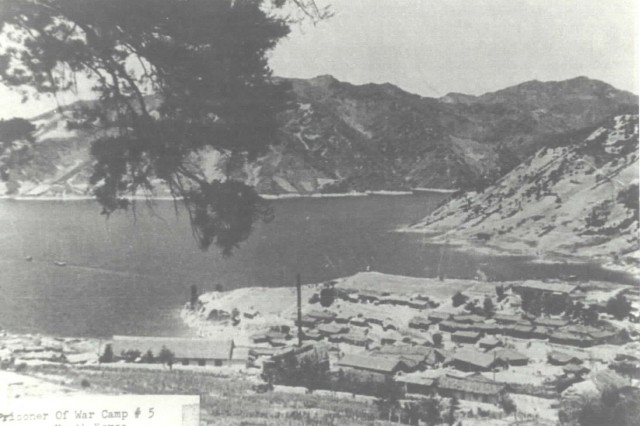
The only known photo of Pyoktong’s Camp #5 (https://media.defense.gov/2021/Mar/17/2002602300/-1/-1/0/210316-A-ZZ999-060.JPG)
As new prisoners joined their ranks, he would be the first to greet them: “My name is Kapaun, glad to have you in our paradise” (Stansifer, p. 282). His personal example, smile, and humor immediately improved morale. He would volunteer for all the work details, often slipping away during them to visit other prisoners, hear confessions, and pray with the men. He buried their dead, cleaned latrines, gathered twigs for fires, fashioned pots and cups out of scrap metal to boil water, washed the feces-stained clothes of POWs afflicted with dysentery, wiped those same POWs’ bottoms, and continued to steal from their captors. According to Captain Robert Burke, a fellow prisoner, “[T]he majority of us had turned into animals, were fighting for food, irritable, selfish…The good priest continued to keep a cool head, conduct himself as a human being, and maintain all his virtues and ideal characteristics….Father proved himself to be the greatest example of manhood I’ve ever seen in my life….[I]t was easier to die than live in those days; death was a welcome relief” (Stansifer, p. 285). In the best sense, Father Kapaun was a good shepherd who truly had the smell of his sheep.
In late January 1951, the POWs marched back to Pyoktong. One hundred and nine began the march; 36 arrived alive but within days that number dropped to 24 (Stansifer, p. 286). Despite this atrocity, Pentagon analysts later determined that the survival rate at Sombokal was much higher than other POW camps during the Korean War, a fact numerous companions of Father Kapaun attribute to his leadership (Stansifer, p. 286). At Pyoktong, at this time renamed “Camp 5”, the POWs lived in groups of 25 men in rooms eight by ten feet with a paper door and armed guard posted outside (Stansifer, p. 277). Once again separated by rank, and also by race, the Chinese began subjecting the POWs to daily reeducation and indoctrination. As the American bodies broke down, the Chinese now sought to break their minds and will to survive. Chaplain Kapaun would calmly refute the communist propaganda during these sessions, earning him the label of “agitator” and subsequent punishment. But the Chinese never punished him too severely for fear of inciting a revolt of the 4,000 prisoners who so clearly revered their chaplain (Stansifer, pp. 294-297).
In his free time, Kapaun continued to volunteer for work details, make pots and tools, and boil clean water. In one attempt to dig up a buried water crock, which he hoped would store larger amounts of clean water than his hand-made pots and pans, a large rock crushed his foot (Stansifer, p. 293). This injury would later lead to a significant blood clot in his leg that nearly killed him. In the final two months of his life, Father Kapaun’s health deteriorated due to his injury and malnutrition. He had also nearly lost an eye when a piece of metal struck it while fashioning one of his homemade pots. But he continued his duties, and in violation of camp policy as “[t]he ice was just breaking on the reservoir,” Kapaun held “Easter Sunrise Services with the Rosary, Memorare, Stations of the Cross, Mass Prayers, and readings from the Bible and hymns” on March 25, 1951 wearing an eye patch and using a cane to walk (Stansifer, p. 302). Prisoners of all faiths attended while the guards nervously watched. Amazingly, they did not interrupt or stop the service as though the coldness of their hearts had melted along with the reservoir. In his homily, Father Kapaun implored the POWs to continue caring for one another and to forgive their enemies (Stansifer, p. 302). It would seem as though the fiery chaplain’s heart had sparked a new springtime in this Korean frozen tundra by his heroic virtue, though sadly winter would return all too soon.
Chaplain Kapaun’s Death and Legacy
By late April Chaplain Kapaun’s weakened state confined him to bed. Slowly starving to death and in intense pain from his blood clot, Chaplain Kapaun turned his prayer books and chaplain kit over to Captain Jim Nardella and charged him with continuing the evening prayers and Sunday services. Despite the American doctors’ care, Kapaun slipped in and out of consciousness and cried frequently. He managed to write out recommended daily prayers on paper for the POWs to continue after his death. The guards soon noticed how ill he had become and saw an opportunity to rid themselves of the “agitator.” They moved him to the “death house,” “a morgue for those not yet dead but fully conscious to suffer a sick and twisted torment right out of an Edgar Allan Poe nightmare” (Stansifer, p. 307).The communists withheld food and water from the POWs sentenced to the “death house” and many died within 24-48 hours of entrance. Kapaun’s fellow POWs protested as the guards carried their beloved chaplain out, to which Kapaun replied, “I’m going where I’ve always wanted to go. And when I get there I’ll say a prayer for you” (Stansifer, p. 308).
Chaplain Kapaun died on May 23, 1951 at the age of 35. The guards ordered that he be buried in a nearby mass grave, but those assigned to the burial detail buried him in his own grave. The Korean War ended a little over two years later, but it would take 68 years to identify his remains. The POWs from Camp 5 brought many of Father Kapaun’s belongings with them out of captivity and returned them to his parents. Unknown to anyone at the time, his remains, along with those in the camp’s mass grave, were repatriated to Hawaii National Cemetery in 1954. The Department of Defense POW/MIA Accounting Agency did not begin testing on Korean War remains until 2019 due to a backlog in World War II remains. Fortunately, Father Kapaun’s younger brother donated a DNA sample to the DoD before his death in 2010. When the agency identified the positive match, it further confirmed Father Kapaun’s identity through “dental records, X-rays, height and age analysis, and circumstantial evidence” (Stansifer, p. 333).
The remains of Emil Joseph Kapaun returned to Kansas on September 25, 2020, receiving a hero’s welcome. After landing in Wichita they went home to Pilsen and lay in wake at his former parish where he had been baptized. His funeral on September 29, 2020 took place in a Wichita arena filled to capacity with his fellow POWs, his nephew, and members of 8th Regiment, 1st Cavalry Division (Stansifer, p. 333). The remains now rest at the Cathedral of the Immaculate Conception in Wichita.
The Diocese of Wichita has submitted his cause for canonization to be declared a saint in the Catholic Church to the Vatican. Although his cause is still under review, several miracles have been attributed to Father Kapaun’s intercession by the people healed after praying to him. Whether named an official saint or not, Chaplain Kapaun’s life points us toward heroic virtue, servant leadership, embracing of suffering, and forgiveness of our enemies. We would be hard-pressed to identify another US military chaplain who did as much for “his boys” in this life and the next as Father Kapaun.

1st Cavalry Division Soldiers bring Father Kapaun back to his parish, St. John Nepomucene, in Pilsen, Kansas on September 25, 2021 (https://obamawhitehouse.archives.gov/blog/2013/04/11/president-obama-awards-medal-honor-father-emil-kapaun-0)
Conclusion
Chaplain Kapaun’s story provides desperately needed hope and inspiration in an era of heightened domestic and global tensions. He humbly served his fellow Soldiers, going above and beyond the call of duty in battle and in captivity. He showed that no suffering comes without meaning or purpose–it has redemptive powers that we can often not identify or make sense of in the moment. But his suffering points us toward the transcendent and reminds us that we are ultimately not made for this world, even though we are of it. Even while suffering, he never remained idle–he continued his industrious habits of doing small, mundane things with great love and humility.
As mentioned in the introduction, Chaplain Kapaun’s military career became the basis for the U.S. military’s code of conduct. By no coincidence, his fellow POW Lieutenant Mike Dowe was later assigned to the Pentagon and worked on POW-related issues for President Eisenhower. The Eisenhower Commission later tasked Dowe with formulating a code of conduct for the military. Despite arguments from other service branches to the contrary, Dowe successfully argued what he learned from Chaplain Kapaun: “I use[d] the comparison of the survival rate of Kapaun Valley with that of the Mining Camp and Death Valley under like conditions. I presented the Army position basing it on how instilling loyalty to God, country and each other, the POW not only becomes a problem for the enemy, but enhances his own chances of survival” (Stansifer, p. 340).
Although I offered a lengthy recount of Father Kapaun’s life in this article, Stansifer’s book is a must read — in its entirety. Largely composed of excerpts from his own interviews and correspondence with people who knew Kapaun, the first-person accounts of Kapaun’s actions are more powerful than anything Mr. Stansifer or I could write on our own.
Finally, if you, like me, hope to see Chaplain Kapaun’s story on the big screen one day, do not worry. Mr. Stansifer has already written a screenplay and tells me it is with top Hollywood talent for review. In the meantime, we can share this humble Kansas chaplain’s story and do our best to live up to his example.
“To serve God adequately men must be loyal and patriotic to their country, a country of freedom, righteousness, and justice of God.” – Chaplain Emil J. Kapaun
Citation:
John Stansifer, No Bullet Got Me Yet: The Relentless Faith of Father Kapaun (Toronto: Hanover Square Press, 2024).
About the Author:
MAJ Brigid Hickman is the senior intelligence officer for 7th Special Forces Group (Airborne). She graduated from the United States Military Academy at West Point in 2011 and has served in the 101st Airborne Division (Air Assault), in the 173rd Airborne Brigade, and at the Pentagon.
Opinions expressed here are those of the author and do not represent those of the United States Army, the Department of Defense, or the United States Government.