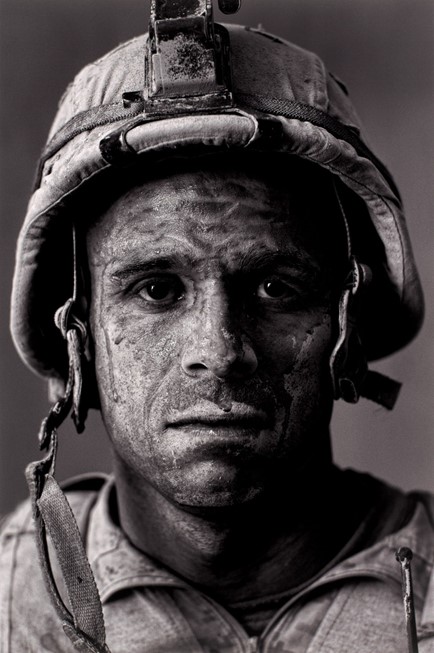
Getting Real about PTSD in the DoD: Augmenting Exposure Therapy Through Virtual Reality
Burning flesh, gunpowder, dirt, rotting garbage and the unmistakable iron-rich bite of blood. Smells redolent of contemporary combat environments snake through the room. A roadside IED explodes and overturns a convoy of armored vehicles, engulfing men and machines in a thick, black smoke and billowing flames. Beads of sweat bud and collect on the hairline of the young woman wearing a portable virtual reality headset as her clinician carefully observes her response. “What would you rate your stress level, ma’am, on a scale of 1 to 8…if 8 is the most distressed you’ve ever felt?” She manages to respond between short, belabored breaths, “Sev…Seven. I’m dizzy… I think….I think I’m gonna be sick.”

For some veterans and servicemembers suffering from post traumatic stress disorder (PTSD), or the more generalized post traumatic stress (PTS), exposure therapy augmented by virtual reality technology has paved their road to relief and recovery. As the longest conflicts in American history carry on in the Middle East, one trend is certain: the demand for treatment of post traumatic stress disorder will persist. A host of reasons suggest that the demand for treatment may actually increase. As the definition of PTSD has broadened to contain not only direct traumatic experiences, but also learning of a traumatic event in which violent or accidental death threatened a close family member or friend, the number of people who meet the clinical threshold for PTSD is expected to steadily grow.
Moreover, if current destigmatization efforts are successful, it is likely that more servicemembers will self-report symptoms and seek treatment. Paired with those destigmatization efforts is a recognition of PTSD emanating not just from combat-related experiences. For non-combat traumas sustained at home or in deployed locations such as sexual assault, training accidents, and first responder situations (e.g. security forces or military firefighters), exposure therapy is often unavailable. Virtual reality exposure therapy (VRET) offers a cost-effective and timely way to increase treatment availability to the broad spectrum of traumas impacting military members.
By the numbers, the need for treatment is significant. Since 2001, the U.S. has deployed more than 2.7 million men and women to contingency operations in or supporting the wars in Iraq and Afghanistan. Between 2000 and 2015, the number of PTSD cases in the military totaled to over 138,000, not including the 40,000 cases that were not related to deployment. Not surprisingly, frequency and intensity of combat experiences influence the incidence of PTSD. This is reflected in the higher rate among Army infantry members that hovers between 10-20 percent. Beyond the moral obligation to provide treatment to our servicemembers and veterans who suffer from PTSD symptoms as a result of duty-related experiences, the cost implications of untreated PTSD – or any mental health condition – creates serious cost ramifications that exacerbate over time.
The World Health Organization estimates that neuropsychiatric disorders, a category to which PTSD belongs, are the leading contributor to Disability-Adjusted Life Years (DALY) in the United States where a DALY represents the total number of years lost to illness, disability, or premature death within a given population. Furthermore, neuropsychiatric disorders are responsible for nearly twice as many DALYs as cardiovascular disease and cancers. The financial impact to society in terms of lost productivity, unemployment, and early retirement is tremendous. However, broadening the aperture beyond a public health perspective to include the DoD’s mission effectiveness as a function of the performance of its servicemembers, the costs are even more alarming.
The DoD’s capability to operationalize the National Defense Strategy is directly dependent on the performance of its servicemembers; across multiple cohorts of servicemembers, evidence strongly suggests that PTSD degrades performance. Despite the demographic differences across generations of servicemembers, each having contended with unique threats, PTSD symptoms have consistently produced adverse outcomes. Clinical studies have revealed a correlation between PTSD symptomology and degraded verbal memory, attention, and executive function. This correlation has been observed in servicemember populations that served in World War II, the Korean War, the Vietnam War, and Desert Storm. As we near the two-decade mark of overseas contingency operations, the population of servicemembers who will have trauma exposure from the current conflicts continues to rise. The exact effects for these servicemembers will remain unknown for years to come, but the insight from historical clinical evidence is clear: making PTSD treatment available now, albeit imperfect, is far superior to no treatment. While the United States is currently conducting a retrograde of its forces in Afghanistan, the invisible wounds of this war will remain with the men and women who fought it. Attention on advancement and availability of treatment is still paramount.
At University of Central Florida (UCF), efforts to use virtual reality to better treat PTSD have been underway for nearly a decade. Behind a set of unassuming double doors on the second floor of the UCF psychology department, a team of talented clinicians guide veterans, active-duty servicemembers, and first-responders through an intensive, three-week exposure therapy treatment protocol. In 2019, the DoD awarded the RESTORES team, led by Dr. Deborah Beidel, with a $10 million U.S. Army contract to further develop its novel virtual reality system. The system prototype, the Traumatic Event Scene Creation System that utilizes VRET, portends a major shift in how the DoD can approach the traumatic experiences of its servicemembers. Beyond just a virtual reality headset, VRET incorporates physiological response sensors and software that enables clinicians to tailor the scene with nuanced, critical detail.
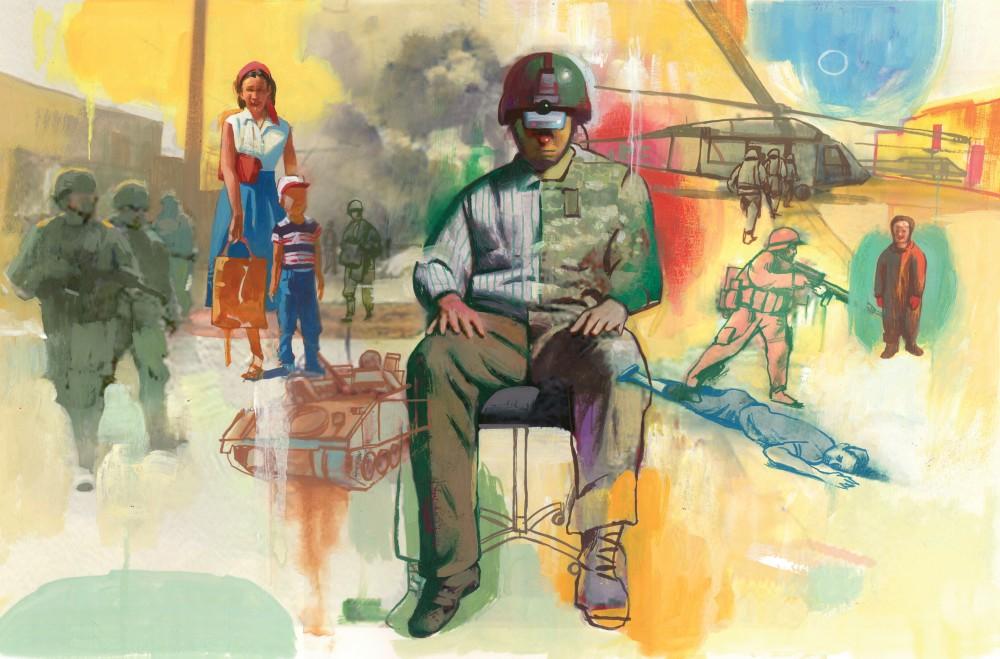
Photo Credit: Larry Moore https://www.ucf.edu/news/ucf-restores-clinic-receives-grant-develop-new-vr-software-treat-ptsd/
Across the country, at the University of Southern California’s Institute for Creative Technologies, the pioneering BraveMind technology has immersed servicemembers in pre-built scenes to treat post traumatic stress since the mid-2000s. BraveMind exposure therapy system continues to produce groundbreaking results but its focus is caged on scenes that typify the current generation’s combat experience: city and desert road environments in Iraq and Afghanistan. While BraveMind informs the foundational blueprint of the RESTORES’ VRET prototype, Dr. Beidel stresses the novel feature of VRET that adds immense value – the ability to specify the placement and actions of people in the traumatic scene. Moreover, VRET is the first of its kind to include scenes that approximate experiences related to sexual assault, accidents, first response and second-hand trauma that civilian spouses or family members may suffer. Clinicians, in conjunction with software engineers who steward VRET’s digital infrastructure, can edit a baseline scene to reflect a patient’s specific traumatic memory environment. As patient scenes gradually accumulate in the VRET database, the potential for implementing machine learning algorithms to quickly customize a scene for a patient will grow. With a growing body of patient scenes and recorded clinical observations, the use of artificial intelligence to make the scene more interactively dynamic also burgeons with possibility.
Prioritizing the recovery of servicemembers suffering from post traumatic stress demands that we ensure they do not drift to the sidelines of society. As Dr. Beidel emphasized, “We have to get people to stop thinking you’re broken…rather, you’re changed forever.”
With its extensive potential, one might assume that the BraveMind treatment protocol is expensive and available only to a select few with ample financial resources. On the contrary, the VR-aided exposure therapy treatment protocol, relative to other evidence-based practices, is inexpensive. The estimated cost of the VRET prototype to include the customizable software, multiple headsets, and audio equipment, is $5,000. The three-week intensive therapy protocol offered at RESTORES, whereby patients work with Master’s-level or higher clinicians five days a week, four to five hours per day, carries a moderate price tag of $7,000. Sixty-six percent of veterans depart RESTORES following the treatment protocol no longer meeting diagnostic criteria. Dr. Beidel highlights a vision of RESTORES to “do therapy differently,” specifically with respect to migrating away from the traditional model of one fifty-minute session per week over months, which can actually reactivate or agitate the trauma. With the RESTORES model, activation of that trauma is still possible but it is addressed immediately and patients are ensconced in a system of continuous support and monitoring.

In the conventional medical lexicon, a treatment’s success ultimately distills to a single word – cure, which implies an end-state return to health or absence of disease. For post traumatic stress, the cure is not so black-and-white, but rather a reduction of functional impairment. If a servicemember is no longer suffering from impairment to the point that he/she can regain the ability to function in daily-life, the treatment is effective. The longer a patient retains this ability to function (and eventually thrive) in daily life, the more cost-effective the treatment. Taking into account the economic and societal value of a servicemember’s return to the workforce, participation in family life, and improved health trajectory, both mental and physical – the costs of treatment, relative to savings, grow increasingly paltry. Prioritizing the recovery of servicemembers suffering from post traumatic stress demands that we ensure they do not drift to the sidelines of society. As Dr. Beidel emphasized, “We have to get people to stop thinking you’re broken…rather, you’re changed forever.”
What makes this treatment program uniquely valuable and effective? The answer lies squarely in the capacity to customize virtual reality scenes to aid both the clinician and patient in pinpointing the traumatic stressor(s). The feeling of realness to the patient is a critical factor in accessing the source of the traumatic trigger and its associated, debilitating stress. The construction of a customized VR scene makes it less likely to overlook meaningful nuances or seemingly innocuous sensory experiences that can galvanize a major stress response. Creating realness hinges on details, demonstrated in one Army veteran’s difficulty in connecting with a scene because his fellow soldiers were wearing Marine uniforms. VR not only allows for quick identification of these oversights, but can correct them as well.

Beyond the visual element, recreation of aural and scent cues enliven the VR scene with significant features of memory. The bright, blinking glow of a ringing cell phone or the incessant cacophony of text message chimes are oft-cited as traumatic stressors for first-responders at mass shootings. While the pungent nose-tickle of a magic marker conjures a childhood recollection for the average person, for first-responders that smell is often an olfactory igniter of traumatic memories tagging bodies for bagging in a mass casualty situation. As Dr. Beidel notes, the hardwired connections between the olfactory glands, the amygdala and hippocampus, which govern our emotions and memory respectively, form a “fourway highway, no turns, to memory.” Exposure therapy with the aid of interactive, multisensory VR provides a vehicle to a comprehensive experience of the traumatic stressor.

Once the traumatic stressor(s) have been identified and depicted in the scene, the clinician has the difficult task of tracking if the patient’s stress response is truly abating. As the patient immerses in the VR scene, the clinician can observe and monitor both the subjective and objective measures of stress. While traditional exposure therapy relies heavily on the patient’s self-reported and inherently subjective stress level, RESTORES has incorporated objective, physiological data such as heart rate and skin conductance sensors (not unlike those used in polygraph machines) to measure a patient’s stress response. The side-by-side comparison of the patient’s self-reported stress and objective physiological data points strongly to whether the VR scene is accurate, and by extension, a useful, targeted treatment tool. Irrespective of the patient’s self-reported stress levels, if physiological measures do not vary, that may suggest to the clinician that the VR scene does not conjure the traumatic event with sufficient verisimilitude.

Because virtual reality scenes offer a portal into a shared representation, clinicians can rectify scenes that are not approximating reality for the patient. When a patient’s physiological stress markers do spike, the data can suggest the part of the scene that aggravates the patient’s stress response. For individuals accustomed to encountering and managing high levels of stress, perceived stress level may vary significantly from physiological stress. The ability to monitor physiological response along the timeline of a traumatic scene gives clinicians the unprecedented opportunity to track if stress is actually attenuating. Only with the use of VR does a clinician have the opportunity to see what the patient sees, study the components, and potentially modify the scene to precisely hone in on the traumatic triggers.
Heart rate and skin conductance unveil a sphere of information previously unavailable to the clinician about the patient’s experience, reducing overreliance on patient-described distress and broadening the scope of clinical assessment beyond the traditional format. Examining current best practices in the treatment of PTSD such as exposure therapy and eye movement desensitization and reprocessing (EMDR), disconnects between the clinician, patient, and the traumatic stressor are difficult to identify and resolve as the patient relies on memory and depicts fragments verbally. VRET not only provides a tool for clinicians to navigate the landscape of a patient’s traumatic stressor, but equips them with the capability to measure with more specificity, document with more detail and iteratively learn from the patient’s response.
VRET fosters a potent blend of patient narrative, empirical data and VR stimuli. Why, then, should servicemembers wait until retirement, medical discharge or even their return from deployment to receive treatment that can alleviate or at least ameliorate the negative health outcomes of traumatic stress? The rapidly growing sector of portable VR can shorten – or possibly altogether end – that agonizing wait. A technology that can be employed and maintained remotely confers immense benefit. Specifically in the case of Forward Operating Bases (FOBs), the value of remote virtual reality therapy cannot be overstated. When servicemembers experience a traumatic event while deployed, portable virtual reality therapy provides the opportunity to address and potentially dramatically curtail long-term stress through timely treatment. If a soldier had a stress fracture, would a doctor send him back on his feet and worsen the injury until it eventually resulted in potentially permanent damage like a bone break?
The answer is an unequivocal no. This attitude of proactive identification and rehabilitation must be mirrored in the sphere of mental health. Both traumatic and chronic stress are inevitable byproducts of the jobs servicemembers perform and the environments into which they are embedded, but ignoring or delaying treatment only increases the likelihood of an acute stress episode that can remove a servicemember from the deployed environment altogether. For conditions of a more physical nature, problems are matched with a fix – an orthopaedic injury requires a methodical protocol for recovery. For traumatic stress, with its often insidious onset and devastating consequences, the same attitude is not present. From a readiness perspective, this conclusion should be avoided at all costs as the servicemember is no longer able to perform his/her duties, which are then redistributed to their organization.
Both traumatic and chronic stress are inevitable byproducts of the jobs servicemembers perform and the environments into which they are embedded, but ignoring or delaying treatment only increases the likelihood of an acute stress episode that can remove a servicemember from the deployed environment altogether.
When a servicemember requires treatment for post traumatic stress (either by request or medical recommendation), portable virtual reality therapy will allow for a brief but intensive treatment protocol similar to the one employed at UCF RESTORES. Three continuous weeks of treatment at a FOB affords the servicemember the chance to realign and rehabilitate, enhancing readiness and performance for the remainder of their deployed duty. Another advantage of portable virtual reality therapy is decreased on-site clinical personnel support. Rather than rely strictly on mental healthcare providers who are in high demand and short supply in a deployed environment, technologies like BraveMind or UCF’s software can link servicemembers to clinical providers who, while not colocated, can guide the exposure therapy session through the portable VR headset. These VR-based protocols lend to computer-based training modules that teach clinicians how to use the software. When in-person treatment is not possible, VRET offers the flexibility for clinicians to apply the protocol remotely. Telemedicine, specifically in the field of mental health, has been growing at an increasingly rapid rate for years, most drastically in the past year. As the pandemic relegated much of non-emergency healthcare onto phones and computers, perceptions on how healthcare can be provided has changed. The military has a rare chance to capitalize on this change in mindset to benefit its servicemembers while also embracing portable virtual reality in its earlier stages of scaled commercialization.
The implementation of portable VR is not a faraway goal requiring exorbitant monetary and time investment – commercial off-the-shelf (COTS) products are available for purchase and programming now. Joe Connelly, Chief of Product at Sketchbox, a leading portable VR company with headquarters in the Bay Area, estimates the price point for each portable headset hovers around $400 and is expected to remain at that point for the foreseeable future, “The reason portable VR is so cheap is because they are based on the same components as a modern day cell phone.” When discussing the feasibility of customizing portable VR headsets for the exposure therapy, he envisions the building of a database similar to that of BraveMind, “We would start by categorizing data into different vignettes, the ones that affect the most people. There is no reason we couldn’t develop that.”
Although desktop-based VR sets offer a more robust graphic processing unit and higher computing power, the associated drawbacks are higher cost, software maintenance, and the obvious limitations imposed by permanent stationing of the equipment. Portable VR headsets provide a more economical route to creating a diffuse, flexible infrastructure of remotely-conducted exposure therapy. Notionally, the process from traumatic exposure in a deployed environment to treatment protocol is simple and capitalizes on everyday technology: an application that uses phone video function enables face-to-face consultation, the servicemember describes his/her experience, the clinician selects a scene that most closely approximates the experience and can control and view the video feed that is ported in from the servicemember’s headset.
Like the iPhone in its first iteration, portable VR has positively disrupted its industry, but significant, rapid improvement is on the horizon. For example, pupil tracking technology, which captures the exact trajectory of the wearer’s eyes, can aid clinicians in determining the point(s) of the traumatic scene on which the servicemember focuses most or where stress spiked most significantly. To scale the distribution and use of portable VR headsets for deployed servicemembers, enterprise tools such as user accounts, dashboard sites and technical support can smooth the implementation process and long-term HIPAA-sensitive data management.
Portable virtual reality technology offers a viable alternative to deliver exposure therapy to more of our servicemembers. Our nation’s security relies on the leadership and service of men and women who are willing to put themselves in harm’s way. They deserve healthcare today that recognizes their sacrifices, alleviates trauma of the past and safeguards hope for the future.
Currently, the DoD is balancing an unprecedented set of threats and crises. Thrust into a state of deep uncertainty, the COVID-19 global pandemic forced the military into responses ranging from reactionary damage control to desperate triage. Communities near and far have reevaluated what really constitutes “normal,” how we define a best practice, and most importantly, where our blind spots lurk. Quarantine measures highlighted a particular deficiency–mental health problems are exacerbating when service members are isolated. As many service members continue work from home on a regular basis, access to vital mental health resources must pivot away from traditional face-to-face formats. As the country cautiously returns to in-person work environments, the potential for future widespread and abrupt quarantine to curb virus transmission must enter our planning frameworks. Preparation for these scenarios is critical to the provision of effective and timely mental health treatment.
Today, for those servicemembers who carry untreated trauma, the need for treatment has never been more urgent. Portable virtual reality technology offers a viable alternative to deliver exposure therapy to more of our servicemembers. Our nation’s security relies on the leadership and service of men and women who are willing to put themselves in harm’s way. They deserve healthcare today that recognizes their sacrifices, alleviates trauma of the past and safeguards hope for the future.
Major Jenn Walters graduated from the United States Air Force Academy in 2011. After serving as a KC-10A instructor pilot, she completed her PhD in public policy at the Pardee RAND Graduate School in Santa Monica, CA. She is currently a speechwriter serving on the Joint Staff, Pentagon, VA.